
The Skyscraper Technique is a link-building strategy that identifies top-performing content and replaces it with a superior version to earn its backlinks. It works by turning average pages into a definitive, resource-rich guide that earns quality backlinks and fully satisfies search intent for Google and AI. The process involves finding proven linkable assets, creating a substantially better version, filtering high-quality prospects, and executing personalized outreach. Its effectiveness is proven by Backlinko doubling traffic with a single guide, AuthorityHacker earning 4,306 backlinks from 4,244 domains, and G2 scaling from zero to over 1M monthly visitors. Its common limits include targeting unreachable authority sites, choosing non-linkable or oversaturated topics, lacking E-E-A-T, and poor outreach segmentation. For the AI era it evolves into Skyscraper 2.0 by combining AI-driven intent analysis, original data, interactive assets, structured schema, and Digital PR hooks.
What Is the Skyscraper Technique in SEO?
The Skyscraper Technique is an SEO method of improving an already successful piece of content and pitching your better version to the sites linking to the original.
Brian Dean from Backlinko created the Skyscraper Technique in April 2013. Neil Patel later popularized this link building method across digital marketing communities. The method relies on a simple skyscraper metaphor. A person looks at the tallest building in a city with awe. Nobody admires the eighth tallest building in that same city. Marketers find the best existing content piece on a topic. They add twenty stories of extra value to that content. They build the most complete resource on the web. This method follows White-Hat SEO principles strictly. Marketers do not copy or plagiarize content from competitors. They research the topic thoroughly to provide maximum user utility. Practitioners also use the Reverse Skyscraper Technique to target different types of competitor assets.
Webmasters link to external sites when their own site lacks a specific resource. These editors form a warmed-up audience for new content. The editors already proved their willingness to link to that specific topic. They accept superior and updated content gladly. The updated content gives better value to their readers.
Why Does the Skyscraper Technique Work for SEO and AI Search?
The Skyscraper Technique works for SEO and AI Search because it replaces average pages with a definitive, resource-rich guide that earns high-quality backlinks, fully satisfies search intent, and gives both Google and AI the structured clarity and original, citable assets they need to rank and reference it.

SERP Ranking Advantage & Organic Backlink Impact
Smart Insights analyzed Google click-through rates across search positions. Their research shows that position one gets 39.8% of all clicks. Position two receives 18.7% of clicks. Position three receives 10.2% of clicks. A study by Backlinko examined first-page Google search results. Their data proves that the number one result has 3.8 times more backlinks than pages in positions two through ten.

Visibility in AI Overviews (AEO & GEO Alignment)
AI search engines cite authoritative web content in their answers. ChatGPT, Claude, Gemini, and Perplexity select pages with strong backlink profiles and clear structured data. Ahrefs studied 75,000 brand domains. Their research shows a 0.664 correlation between branded web mentions and Google AI Overview visibility. Search engines and AI models evaluate Information Gain. Ahrefs and seoClarity guidelines state that new content must provide 20% to 30% unique information. Unique information includes proprietary survey data, case studies, or custom interactive tools. Earning backlinks across high-authority websites increases a brand Share of Model score in AI search systems.
Local SEO & Business Growth Benefits
Local service businesses use skyscraper content to earn local backlinks. Plumbers, locksmiths, and car service centers transform dry government charts into visual guides. B2B SaaS companies use skyscraper guides to generate organic referral traffic. These assets build brand authority and increase customer conversions.
What Are the Steps of the Skyscraper Technique?
The Steps of the Skyscraper Technique are finding proven linkable assets, creating a superior version, filtering high-quality prospects, and executing personalized outreach. Each step is explained in detail below.

Step 1: Finding Proven Linkable Assets
Marketers search for existing content with high backlink counts.
- By Competitor Domain: Marketers enter competitor URLs into Ahrefs, Semrush, Ubersuggest, seoClarity, Majestic, or BuzzSumo. They sort pages by referring domains. An example from seoClarity Research Grid shows that a page for the keyword ‘how to buy a home’ holds 8,702 backlinks from 1,257 unique domains. Another example shows a page on apartments.com for ‘picking a roommate’ with 41 unique referring domains.
- By Keyword Research: Marketers use Google Keyword Planner, Moz, Ubersuggest, or seoClarity to analyze search keywords. They evaluate monthly search volume, Cost Per Click, and Keyword Difficulty scores.

Step 2: One-Upping Existing Content
Marketers create content that outperforms competitor pages across all metrics.
- Make It Thorough & Actionable: Authors add missing subtopics to competitor guides. They explain difficult terms and add detailed step-by-step instructions.
- Keep It Fresh: Publishers update outdated stats, replace broken links, and update old software screenshots. Brian Dean updated old ranking factor lists by adding social signal factors.
- Brighter Design & User Experience: A survey shows that visual content creation represents the biggest challenge for 23.7% of content marketers. Marketers create custom header banners and infographics to attract links.
- Interactive & Multimedia Elements: Publishers embed interactive quizzes, calculators, video clips, and visual charts to increase user engagement.
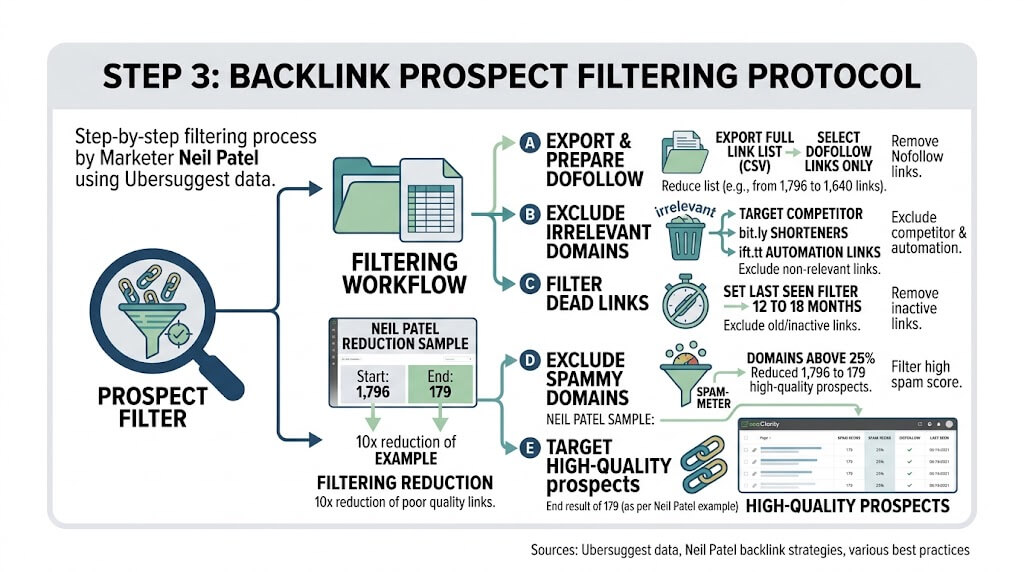
Step 3: Backlink Prospect Filtering Protocol
Marketer Neil Patel outlined a step-by-step backlink filtering process using Ubersuggest data.
- Export the full backlink list from SEO tools into a CSV spreadsheet.
- Filter the list to include Dofollow links exclusively. Neil Patel reduced a sample list from 1,796 links to 1,640 links with this filter.
- Exclude the target competitor domain name, bit.ly shorteners, and ift.tt automation links.
- Set the Last Seen filter to 12 to 18 months to remove dead links.
- Filter out domains with a Spam Score above 25%. Neil Patel reduced his target list from 1,796 options to 179 high-quality prospects.

Step 4: High-Converting Email Outreach & Automation
Marketers send personalized cold outreach emails to target webmasters. They segment prospect lists by anchor text to customize email offers. Snov.io provides a contact database of over 700 million records with 97% accuracy. Marketers use outreach platforms like Snov.io, Hunter.io, Respona, Pitchbox, or Mailshake. A 1% to 5% response rate represents a successful outreach campaign.
What Real-World Case Studies Prove the Skyscraper Technique Works?
Real-world case studies prove the Skyscraper Technique works through Backlinko doubling traffic with one guide, AuthorityHacker earning 4,306 backlinks from 4,244 domains, and G2 scaling from zero to over 1M monthly visitors.

Backlinko Case Study
Brian Dean published ‘Google 200 Ranking Factors’ on April 18, 2013. He gathered, updated, and explained every ranking factor in one guide. His website organic search traffic doubled (+110%) in 14 days. His organic traffic increased by 652% in 7 days. This single blog post generated over 2,000,000 referral visitors to his website. Brian Dean sent outreach emails to 160 selected prospects. He achieved an 11% outreach conversion rate.

AuthorityHacker Case Study
AuthorityHacker conducted a 3-year link building campaign across 78 email outreach campaigns. They used Ahrefs to identify high Keyword Difficulty keywords. They used Hunter, Snov.io, and Mailshake for email research and outreach. They processed 152,000 prospects and sent 630,000 emails. AuthorityHacker earned 4,306 backlinks from 4,244 unique referring domains.

G2 Case Study
G2 used the Skyscraper Technique to grow its Learn Hub platform. G2 scaled its site traffic from zero to over 1,000,000 monthly visitors in one year. Ahrefs data shows that G2 Learn Hub holds over 137,629 backlinks from authoritative websites.

FoodSafety.gov, Fundera & Other Success Stories
Digital Third Coast analyzed a food storage chart on FoodSafety.gov. The original government chart had a Page Authority of 81, a Domain Authority of 89, and 400 referring domains. Visual.ly converted this chart into an infographic called ‘Shelf Life of Food’. Visual.ly earned 50 unique domain backlinks and a Page Authority of 72. Fundera created custom illustrations for every grant on their female business grant guide. Fundera outperformed Nav in user experience and organic search traffic. Ryan Robinson generated over 70,000 visitors from a single skyscraper post. Wix linked to Neil Patel guide on page loading times to cite an authoritative source.
What Are the Common Mistakes and Limits of the Skyscraper Method?
The common mistakes and limits of the Skyscraper Method are targeting unreachable authority sites, non-linkable or oversaturated topics, lacking E-E-A-T, and poor outreach segmentation.
Strategic & Domain Authority Pitfalls
Marketers fail when they overestimate their domain authority reach. Neil Patel notes that a site with a Domain Authority of 49 cannot easily replace links on Search Engine Journal with a Domain Authority of 89. Marketers must target referring sites within their own Domain Authority tier first. Targeting broad keywords like ‘SEO’ creates unfocused campaigns. Failing to segment email lists by anchor text reduces response rates. Lacking author E-E-A-T credentials lowers brand trust.
When the Skyscraper Technique Won’t Work
The method fails when a topic lacks link potential. Specific product features and internal company processes do not attract external links. Transactional search queries for product sales pages require checkout pages instead of informational guides. Oversaturated topics with dozens of existing skyscraper guides yield poor results. Brand new domains without topical authority struggle to earn links.
How to Upgrade the Skyscraper Technique for the AI Era? Entering Skyscraper 2.0
The Skyscraper Technique for the AI Era should be upgraded by combining traditional outreach with AI-driven intent analysis, original data, interactive assets, structured schema, and Digital PR story hooks.
Data-Backed Evolution
Industry polling data highlights a shifting perspective among link building professionals. Ahrefs, Editorial.Link, uSERP, and Aira conducted 4 major LinkedIn polls with over 1,500 total votes from SEO practitioners. 61% of surveyed SEO professionals still believe that the Skyscraper Technique works. However, only 6.2% of respondents rank traditional Skyscraper as their most effective link building tactic. 62% of surveyed practitioners state that topical relevance matters more than content length. 50% of respondents vote for content marketing and Digital PR as stronger link acquisition tactics than standalone Skyscraper campaigns. These industry survey results prove that traditional content length alone no longer guarantees outreach success. SEO professionals must upgrade traditional Skyscraper workflows into Skyscraper 2.0 by combining core Skyscraper outreach with original data assets and Digital PR story hooks.

AI Agents & Multi-Step Content Pipelines (MCPs)
Marketers use ChatGPT, Claude, Gemini, and Ubersuggest MCP to analyze search intent. Multi-step content pipelines automate competitor research, query clustering, and outline creation. AI agents build personalized outreach sequences for target editors.
Original Data & Interactive Asset Integration
Publishers integrate proprietary survey data, case studies, and structured schema markup into their pages. They embed interactive calculators, quizzes, and visual charts. These unique assets establish brand topical authority and secure AI search citations.
Can SaaS companies use AI agents and Digital PR to scale Skyscraper 2.0?
Yes, SaaS companies can scale Skyscraper 2.0 by using AI agents and MCPs to automate competitor research and query clustering and using Digital PR story hooks to pitch the data-driven asset to top-tier publications.
Does the Skyscraper Technique work for SaaS link building?
Yes, it is highly effective for SaaS link building because replacing average listicles with a data-backed, product-led guide earns authoritative backlinks and drives qualified trial signups.
Can the Skyscraper Technique be combined with guest posting?
Yes, guest posting can amplify Skyscraper results by using the superior asset as proof of expertise to secure contextual placements on high-authority sites.
Does the Skyscraper Technique generate brand mentions without backlinks?
Yes, even without a backlink, a superior Skyscraper resource often earns a brand mention as a trusted source, which builds topical authority.
Is broken link building the same as the Skyscraper Technique?
No, broken link building is different. It replaces a dead link with similar content, while Skyscraper replaces a live but average page with a substantially better version.
Is Skyscraper Technique better than link insertion for long-term authority?
Yes, Skyscraper technique is better for long-term authority because it earns editorial links to an owned asset, while link insertion only secures a quick contextual mention in existing content.
Leave a Reply