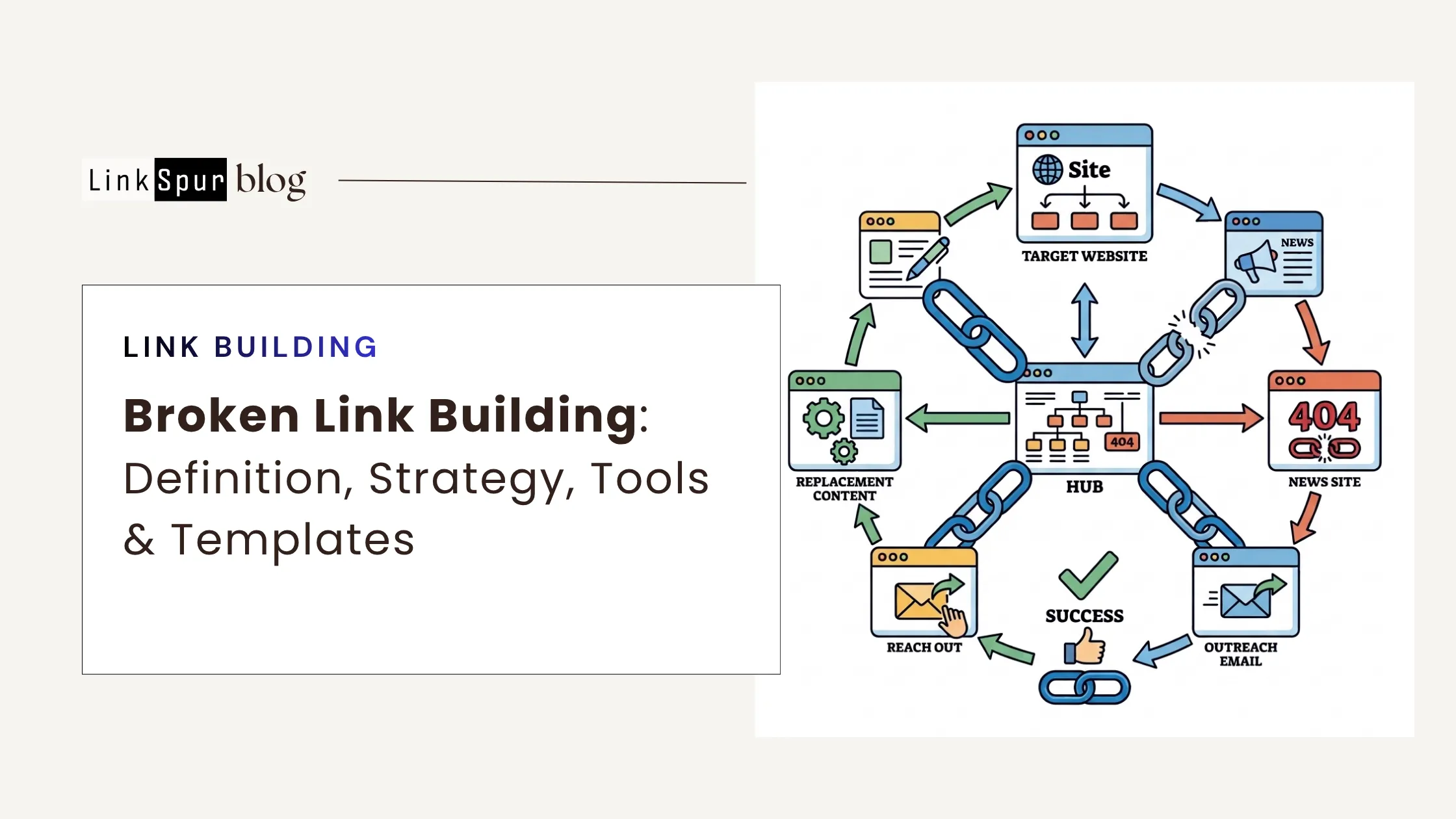
Broken link building is a value-first link building strategy that involves repairing broken external links for webmasters in exchange for contextual backlinks and qualified referral traffic. Replacing 404 dead ends delivers immediate technical SEO benefits for publishers while elevating your domain authority and search performance. With web decay causing 20% of links to break over time, this method delivers consistent 7 to 15% conversion rates.
The campaign process follows 6 structured steps: target prospecting, context qualification, metric vetting, historical reconstruction, replacement creation, and outreach with campaign tracking. Specialized software like Ahrefs, Semrush, and Hunter.io, combined with advanced Google search operators, pinpoints valuable dead link opportunities.
Archival research on the Wayback Machine guides the creation of superior skyscraper content. Sending personalized, non-spammy pitches builds authentic relationships, ensuring your backlink profile drives rankings on traditional search engines as well as generative AI search platforms like ChatGPT and Perplexity.
What Is Broken Link Building and How Does It Work?
Broken link building is a white-hat SEO technique where you find inactive outbound links on external websites, create or identify relevant replacement resources, and request webmasters to replace dead URLs with your active links.

Search engine optimization requires consistent backlink acquisition to signal domain authority to search crawlers. Traditional link building relies on cold outreach begging, which yields low response rates from busy website editors.
Broken link building operates on the psychological principle of reciprocity. You deliver immediate value by finding technical website errors, and webmasters reward your assistance by linking to your content.
Core Terminology for SEO Practitioners
The following list details the essential technical terms every digital marketer must master before starting a broken link building campaign:
- 404 Not Found Status: An HTTP response code indicating that the web server cannot locate the requested URL because the page was deleted or moved.
- Hyperlink / Backlink: An HTML element connecting one web page to another, transferring referral visitors and ranking power across domains.
- Link Equity (Link Juice): The quantitative SEO value and authority passed from a linking page to a target URL through hyperlinks.
- Referring Domain: A unique root domain address containing one or more outbound backlinks pointing to an external site.
- Dofollow vs. Nofollow: Dofollow links allow search engines to pass PageRank equity, whereas rel=’nofollow’ attributes instruct crawlers to skip equity transfer.
- Soft 404 Error: A page that displays a ‘Not Found’ message to users but returns a 200 OK status code to search crawlers.
Technical Causes of Web Link Decay
Hyperlinks break continuously over time through five primary technical triggers:
- Permanent Page Deletion: Webmasters delete old blog posts or product pages without setting up server redirects.
- Unredirected Redesigns: Companies change domain permalink structures or migrate CMS platforms without installing 301 permanent redirects.
- Domain Name Expiration: Site owners fail to renew domain registrations, causing entire site architectures to disappear overnight.
- Manual Typographical Errors: Content editors accidentally mistype destination URLs during manual article formatting.
- Removed Academic Data: Institutions archive or remove older research reports, white papers, and survey datasets.
ADVANCED DIAGNOSTIC TIP: Always check the HTTP header status code using cURL or developer tools. A true 404 error is required for broken link building, whereas a 302 temporary redirect indicates the page may return soon.
Why Should You Use Broken Link Building for SEO?
Broken link building provides a rare win-win opportunity by solving technical errors for site owners while earning authoritative backlinks for your brand.
Target webmasters benefit directly from your outreach because broken links hurt user experience and leak PageRank equity. Your notification saves them time and money on technical site audits.
Your website gains contextual backlinks from high-authority domains that usually reject cold pitches, including news outlets, universities, and government portals.
The following table compares the operational differences between traditional cold link outreach and broken link building:
| Strategic Dimension | Traditional Cold Link Outreach | Broken Link Building Campaign |
| Primary Value Proposition | Asks for a backlink favor with no upfront value. | Fixes a technical broken link on their website. |
| Webmaster Perception | Perceived as unsolicited marketing spam. | Perceived as helpful technical auditing assistance. |
| Average Response Rate | 5.0% – 10.0% response rate. | 15.0% – 25.0% response rate (up to 45% with screenshots). |
| Target Domain Quality | Limited mainly to commercial blogs. | Reaches high-authority .edu, .gov, and news publications. |
What is Link Rot?
Link rot refers to the natural decay of hyperlinks over time as web pages are deleted, moved, or expired. While link rot is the technical problem that breaks web navigation, broken link building is the SEO strategy that turns these dead ends into backlink opportunities.
What Do Link Rot Statistics Reveal About Web Decay?
Empirical research proves that approximately 20% of internet links are broken, providing millions of link acquisition opportunities across all publishing industries.
The internet decays at an extraordinary rate as published pages are moved, modified, or permanently deleted. Industry studies quantify this decay and highlight the scale of broken link opportunities.
The following list details major statistics on web link decay and campaign conversion benchmarks:
- Pew Research Center (May 2024): 38% of all web pages existing in 2013 are no longer accessible today. Additionally, 23% of news pages and 21% of government sites contain at least one broken link.
- Long-Term 20-Year Web Decay: Over a 20-year span, approximately 98% of all external hyperlinks on the open web break completely.
- Massive 6.3 Million Link Study: In an analysis of 6,325,915 external links, 16.63% were broken and 35.2% of homepages contained at least one dead external link. Overall, 20% of external web links are broken.
- Ahrefs 9-Year Historical Study: Ahrefs discovered that 66.5% of backlinks pointing to sites created 9 years ago have completely disappeared.
- Outreach Reply & Conversion Rates: Broken link campaigns achieve 15% to 25% reply rates compared to 5% to 10% for cold outreach. Conversion rates average 7% to 15%, reaching 28.8% to 45.0% when personalized screenshots are included.
- Effort & Labor Investment: Acquiring a single backlink requires 3 to 5 hours of effort. Results take 4 to 6 weeks to show ranking improvements, and AI tools increase prospecting efficiency by 54%.
- Industry Adoption & Success: 13.3% of marketers deploy broken link building actively (DemandSage), and 37% of SEO experts use it in their strategy. Aira ranks it as the 5th most popular tactic globally.
How Do You Find Broken Links Step by Step?
Executing a successful broken link building campaign requires a 6-step process: prospect target sites, qualify relevance, vet domain quality, analyze archival content, create superior replacements, and conduct targeted outreach.

Skipping qualification or verification steps leads to low conversion rates and wasted outreach effort. Marketers must systematically execute each phase to maximize backlink acquisition.
The following list outlines the sequential operational steps of a broken link building campaign:
- Step 1 – Target Prospecting & Discovery: Find broken link opportunities using two flexible methods. If you are auditing a specific competitor or high-authority site, run their URL through LinkSpur’s Broken Link Checker to reveal every broken outbound link. If you want niche-specific resource pages, generate targeted search queries with the Google Dork Generator to uncover hidden target opportunities.
- Step 2 – Context & Relevance Qualification: Review the broken links discovered during prospecting to confirm the dead content directly matches your target niche. This ensures you only invest time into opportunities where your replacement content provides genuine value to the site owner.
- Step 3 – Prospect Vetting & Quality Control: Evaluate the qualified target sites to ensure domains have solid authority (DR 30+ or DR 5+ minimum), support Dofollow link placements, and maintain active organic search traffic.
- Step 4 – Historical Archival Analysis: Inspect the dead URLs using the Wayback Machine to analyze the original content, user intent, key data points, and linking context so your replacement page naturally fills the gap.
- Step 5 – Superior Replacement Creation: Publish an upgraded replacement resource using the Skyscraper Technique, adding updated stats, clear tables, infographics, or tools to make your page the obvious choice for webmasters to link to.
- Step 6 – Outreach & Campaign Tracking: Find direct contact info for site editors or webmasters, send personalized pitches referencing the broken link, and log every interaction in a CRM spreadsheet to track replies and placements.
Which Search Operators and Tools Find Dead Links Best?
You can uncover broken link opportunities using Google search operators for resource pages, Wikipedia dead link searches, competitor 404 audits, and expired domain databases.
Resource pages are curated directories of external links maintained by industry blogs, universities, and organizations. These pages frequently accumulate broken links over time.
The following code box contains the exact Google search operators used to find niche resource pages:
“keyword” + inurl:resources
“keyword” + intitle:links
“keyword” + “helpful resources”
“keyword” + “useful resources”
“keyword” + inurl:”recommended links”
“keyword” + inurl:”suggested links”
Executing `”cybersecurity” + inurl:resources` returns curated cybersecurity resource pages. Running browser link checkers like Check My Links instantly highlights dead URLs in red.
The Wikipedia Dead Link Extraction Strategy
Wikipedia editors tag broken external citation references with `[dead link]`. Earning links on Wikipedia builds referral traffic and establishes secondary visibility across authority blogs.
The following code box shows the exact search query for finding dead links on Wikipedia:
site:wikipedia.org “keyword” “dead link”
Copy the broken destination URL found in Wikipedia references and run it through Ahrefs or Semrush. This reveals dozens of third-party websites linking to that same dead resource.
Competitor 404 Backlink Extraction
Competitor websites often delete pages without setting up 301 redirects, leaving high-authority backlinks pointing to dead URLs.
Input a competitor’s domain into Ahrefs Site Explorer, open the ‘Best by Links’ report, filter by HTTP status code ‘404 Not Found’, and export referring domains linking to those dead pages.
Expired Domain Backlink Harvesting
Search ExpiredDomains.net for expired domain names within your industry sector. Filter for domains with clean backlink profiles and extract all external sites linking to their inactive pages.
How Do You Recreate Dead Content Using the Skyscraper Technique?
Recreating dead content requires analyzing historical snapshots on the Wayback Machine and creating a superior, updated resource that matches original linking intent.
Finding a broken link is only half the battle. Your replacement content must convince webmasters that swapping the dead link for your URL significantly improves their website.
Paste dead URLs into the Wayback Machine (archive.org) to examine historical snapshots. Analyze why external authors originally cited the page, whether for raw statistics, definitions, step-by-step guides, or downloadable templates.
Differentiate between Deep Links and General Links during archival analysis. Deep Links cite specific statistics or quotes, requiring exact matching replacement data. General Links cite broad topics, allowing comprehensive guide replacements.
Apply the Skyscraper Technique by making your replacement page noticeably superior. Never copy historical text directly; instead, add updated 2026 data, clear charts, expert quotes, and actionable takeaways.
GUEST POST ALTERNATIVE STRATEGY: If your website lacks a relevant replacement page and you cannot publish one immediately, write a guest post on a high-authority publication like HubSpot or Entrepreneur and pitch that URL as the replacement resource.
Which Outreach Email Templates Get the Highest Response Rates?
Personalized email pitches with exact broken link locations, visual screenshots, and concise replacement suggestions generate response rates between 25% and 45%.
Generic automated spam leads to instant email deletions. High-converting outreach targets specific editors, demonstrates genuine value, and complies with CAN-SPAM regulations.
The following three email templates provide proven outreach frameworks for different broken link acquisition scenarios:
Template 1: Resource Page Broken Link Pitch
Use this template when contacting editors who manage curated industry resource directories:
Subject: Broken link on your [Topic] resource page
Hi [Name],
I was reviewing your [Resource Page Title] page today while researching [Topic]. You have put together a great list of references!
I noticed that one of your outbound links is broken:
– Page URL: [Their Resource Page URL]
– Dead Link: [Broken Link Text / URL]
– Error Type: Returns a 404 Not Found error.
I recently published a detailed guide on [Topic] that covers [Key Unique Data Point / Benefit]:
[Your Page URL]
If you are updating the page, my guide might make a helpful replacement for your readers.
Best regards,
[Your Name]
[Your Title]
Template 2: Competitor 404 Backlink Replacement Pitch
Use this template when targeting webmasters who link to a deleted competitor page:
Subject: Quick heads up regarding [Competitor Content Topic]
Hi [Name],
I came across your article on [Their Article Title] while looking for information on [Topic]. Excellent overview!
I noticed that your link pointing to [Dead Competitor Page Title] ([Dead URL]) is no longer active. It looks like they deleted the page without a redirect.
We recently updated a comprehensive resource on [Topic] that includes [Updated Statistics / New Visuals]:
[Your Page URL]
Thought I would pass this along in case you want to fix the dead reference for your visitors.
Cheers,
[Your Name]
Template 3: Soft Conversational Value-First Pitch
Use this template to establish rapport before suggesting your replacement URL:
Subject: Small broken link on [Website Name]
Hi [Name],
I was reading your guide on [Article Title] and found it really helpful, especially the section on [Specific Detail].
Just wanted to let you know that the link pointing to [Broken Resource Name] seems to be broken now. It gave me a 404 error when I clicked it.
I actually published an updated research study on that exact topic on my site. Let me know if you’d like me to send over the link to see if it fits as a replacement!
Best,
[Your Name]
Send 1 to 2 polite follow-up emails maximum, spaced 5 to 7 days apart. If the webmaster does not respond after two follow-ups, archive the prospect to maintain domain sender reputation.
What Are the Ethics and Common Mistakes in Link Building?
Ethical link building requires honesty, CAN-SPAM compliance, and value delivery, while avoiding deceptive tactics like author impersonation, spammy outreach, or buying links.
Maintain strict ethical boundaries during campaign execution. Never impersonate original authors, do not buy expired domains solely to redirect link equity, and avoid demanding exact match anchor text.
Comply strictly with CAN-SPAM regulations by avoiding deceptive subject lines, including your physical business address, and honoring opt-out requests immediately.
The following list highlights the most common operational mistakes to avoid:
- Generic Email Spamming: Sending unpersonalized bulk outreach emails destroys sender reputation and yields near-zero conversions.
- Inferior Replacement Content: Pitching low-quality or irrelevant blog posts fails to convince editors to replace dead links.
- Targeting Low-Quality Sites: Wasting time on zero-traffic domains, abandoned blogs, or spam directories yields no ranking benefit.
- Aggressive Follow-Up Tactics: Harassing site owners with daily follow-up emails results in domain blocking and spam reports.
Is Broken Link Building Scalable Compared to Digital PR?
Broken link building is difficult to scale independently because it relies on external errors, making it most effective when paired with Digital PR and listicle placements.
Broken link building is a reactive SEO strategy reliant on unpredictable external site errors. Manual prospecting and verification limit the sheer volume of links you can acquire monthly.
Proactive strategies like Digital PR campaigns and listicle placements offer far greater scalability. Digital PR generates high-authority media coverage and brand citations rapidly across major news outlets.
Listicle placements and active PR campaigns also drive AI search engine visibility. Modern search algorithms like ChatGPT, Claude, Gemini, and Perplexity aggregate citations from frequently cited web pages.
The following table summarizes the strategic comparison across link building methodologies:
| Strategy Category | Scalability Potential | Primary SEO Benefit | AI Search Visibility Impact |
| Broken Link Building | Low to Medium (Reactive) | High-authority niche backlinks & UX repair. | Moderate referral citations. |
| Digital PR Campaigns | High (Proactive) | Massive media coverage & domain authority. | High LLM training citations. |
| Listicle Placements | High (Proactive) | Targeted referral traffic & keyword rankings. | High AI search recommendation frequency. |
Which SEO Tools and Software Checklist Should You Use?
A complete broken link building tech stack includes SEO analytics platforms, browser link extensions, contact lookup tools, archival software, and outreach automation platforms.
Leveraging specialized software accelerates manual URL evaluation and streamlines campaign management. Combining these tools maximizes prospecting efficiency.
The following list categorizes the complete toolset required for executing broken link building campaigns:
- SEO & Backlink Analytics: Ahrefs, Semrush, Moz Pro / Link Explorer, Screaming Frog SEO Spider, SEO PowerSuite (SEO SpyGlass, LinkAssistant), Seobility, Serpstat, Ubersuggest, Google Search Console.
- Link Auditing & Prospecting Tools: LinkSpur Broken Link Checker (for bulk sitemap scanning and 404/410 verification), LinkSpur Google Dork Generator (for niche search prospecting).
- Browser Link Checker Extensions: Check My Links (Chrome), LinkMiner, Atomseo Broken Link Checker, Ahrefs SEO Toolbar, LinkChecker (Firefox).
- Contact Lookup & Verification: Hunter.io, Snov.io, RocketReach, Voila Norbert, Skrapp, Clearbit, Wiza, ZeroBounce, Prowly.
- Archival Content Analysis: Wayback Machine (Archive.org).
- Outreach & Campaign Automation: Respona, BuzzStream, Lemlist, JustReachOut, Smartlinks.ai, LinkAssistant.
Is broken link building the same as converting unlinked brand mentions?
No. Broken link building replaces dead 404 URLs with your working content, while converting unlinked brand mentions turns existing plain-text brand citations into active hyperlinks.
Can you combine broken link building with Digital PR?
Yes. Combining broken link building with proactive Digital PR strategies helps you fix technical web errors while securing high-authority editorial links at scale.
Does broken link building yield higher reply rates than guest blogging?
Yes. Broken link building often achieves higher initial response rates (15%–25%), though guest blogging gives you greater control over anchor text and content placement.
Do you need the Skyscraper Technique for broken link building?
Yes. Applying the Skyscraper Technique allows you to analyze archived dead pages and build superior replacement resources that editors prefer linking to.
Are linkable assets effective as replacement content for dead links?
Yes. Publishing comprehensive linkable assets like ultimate guides, calculators, and research studies, significantly increases your outreach conversion rates.
Does broken link building work for SaaS websites?
Yes. Broken link building is highly effective for software companies when combined with targeted SaaS link building tactics to replace dead tool directories or outdated software guides.
Do beginners need to learn technical link building terms before starting?
Yes. Understanding core concepts like 404 errors, 301 redirects, and link rot is essential; you can explore our complete SEO link building glossary for 130+ terms and definitions.
Do you need specialized tools to run a broken link building campaign?
Yes. Using backlink checkers, browser extensions, and outreach software speeds up prospecting; check our curated list of link building tools to find the right software.
Leave a Reply